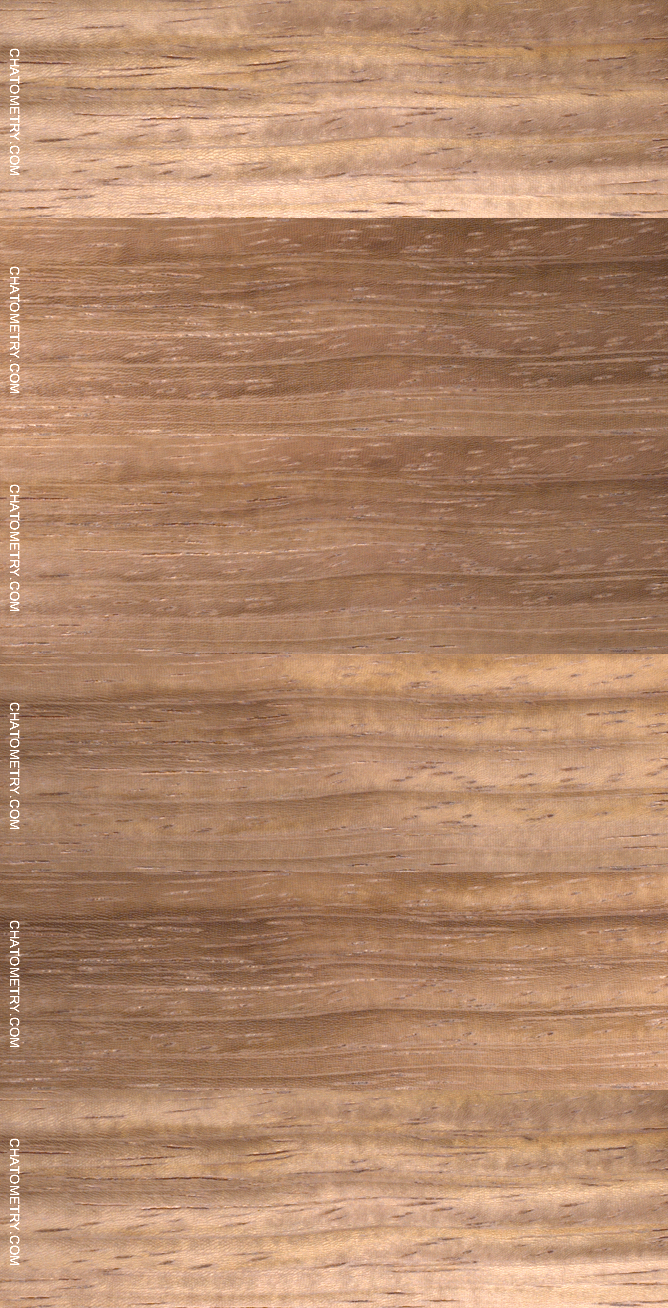
sindoropsis letestui, Fabaceae, Angiospermae (Hardwood)

Other names: Lumbandjii, Ngom
Chatoyance was measured by the chatometry.com team using the PZC method. The statistics for this specific timber are hereby summarized to provide an evaluation of data robustness:
Number of sources for samples: 1
Number of individual trees analyzed: 1
Number of specimens: 3
Number of measurements: 9
Max PZC read (of all measurements): 23.9
Min PZC read (of all measurements): 19.8
Max PZC average on one log: 21.3
Min PZC average on one log: 21.3
PZC Average of all logs: 21.3
Species: sindoropsis letestui
Family: Fabaceae
Clade: Angiospermae
Description: A large tropical tree with pinnate leaves, small yellowish-white flowers in panicles, and flat, woody pods.
Other Local Names: Lumbandjii, Ngom
Reference Colour: Pinkish brown
Texture: Medium
Grain: Straight or interlocked
Interlocked Grain: Slight
Notes: Wood pink brown with cooper glints, darkening in the light. Possible presence of wind shakes (internal fractures in wood). Resin canals, mainly in sapwood.
Diameter: 70÷100cm
Density @12% MC: 720kg/m³
Janka Hardness: 1620lbf
Crushing Strength @12%MC: 61MPa
Static Bending Strength @12%MC: 115MPa
Longitudinal Modulus of Elasticity E: 18.64GPa
Volumetric Shrinkage Coefficient: 0.55% per %
Total Tangential Shrinkage TS: 6.8%
Total Radial Shrinkage TS: 3.7%
T/R Anisotropy Ratio: 1.8-
Fibre Saturation Point: 22%
Thermal Conductivity: 0.24W/mk
Sapwood Thickness: 8÷10cm
Sapwood Demarcation: Clearly demarcated
Resistance to Decay: Class 3 – moderately durable
Resistance to Dry Wood Borers: Class D – durable (sapwood demarcated, risk limited to sapwood)
Resistance to Termites: Class M – moderately durable
Treatability: Class 2 – moderately treatable.
Use Class Covered by Natural Durability: Class 2 – inside or under cover (dampness possible) Atlas of Tropical Timber Species GHÉOMBI
Log Buoyancy: Does not float
Log Conservation: Moderate (treatment recommended)
Drying Rate: Slow
Drying Risk of Distortion: High risk
Drying Risk of Case Hardening: No known specific risk
Drying Risk of Checking: Slight risk
Blunting Effect: Fairly high
Sawing Tooth: Stellite-tipped
Machining Tool: Tungsten carbide
Suitability for Peeling: Good
Suitability for Slicing: Good
Sawing Machining Notes: Sometimes clogging of sawblades and tools due to resin. Irregular grain may cause a fuzzy surface in planing.
Assembly Nailing Screwing: Good
Additional Notes: Low yield due to resin canals and wide sapwood
End Uses: Framing, Interior joinery, Formwork, Built-in furniture or mobile item, Boxes and crates, House framing, Veneer for back or face of plywood, Flooring, Veneer for interior of plywood, Sliced veneer, Exterior joinery
Source 1: Tropical Timber Atlas, Editions Quae, e-ISBN 978-2-7592-2770-9
[Previous] —————— [Next]
Want to know more? Get Woodworker’s Guide to Chatoyance!

… and enjoy the read!